The brick in my tiny studio apartment had a new musk to it. The sheets felt stale, lived-in in a way that felt unfamiliar to me no matter how I changed or washed them.
My heart had been broken by a man who was never mine. And as I lay across my couch, Bon Iver on full blast with a sad amount of Uber Eats en route, I looked at flights. One month in Tennessee, two months in Costa Rica.
I had plans to return to my hometown to write my book. In a city I left behind, because when it was my time to go, there was no one left to leave there.
Back in the Southeast, college friends who remained in our college town reminded me of what I left behind. Something they called bravery while I called it necessity. Today, they’ve built lives and houses where mine have been leveled for new, unfamiliar buildings.
At 17, I had watched my family fall apart in a wave of tragedy meant for god-awful Lifetime movies.
The sudden death of my mother drove my dad back into the arms of crime—one that would eventually take him to prison. My siblings, that I knew of, were drug-addicted and spread across the East.
What tethered me to Tennessee’s red clay mud had been ripped out, roots and all.
So when the wind wanted to guide me to New York City, to Los Angeles, to San Francisco, and, today, to Costa Rica, I had nothing to look back to and everything ahead of me.
Because when you have nothing to hold onto, you have everything to reach for.
When I met Ben at a cafe beachside in the sticky morning heat that made up the Pacific coast in Central America, I felt a familiar tug at my heart.
“I have no one,” he said to me, gripping the edge of the wooden rocking chair to ease himself down. I wanted to help, but he insisted that he was not incapable yet.
He and his wife were married for 37 years, most of which, he joked, had worked out because he spent a good deal of that time traveling. I’m not sure how their story ended—whether in death or legal separation—I didn’t ask.
So, Ben.
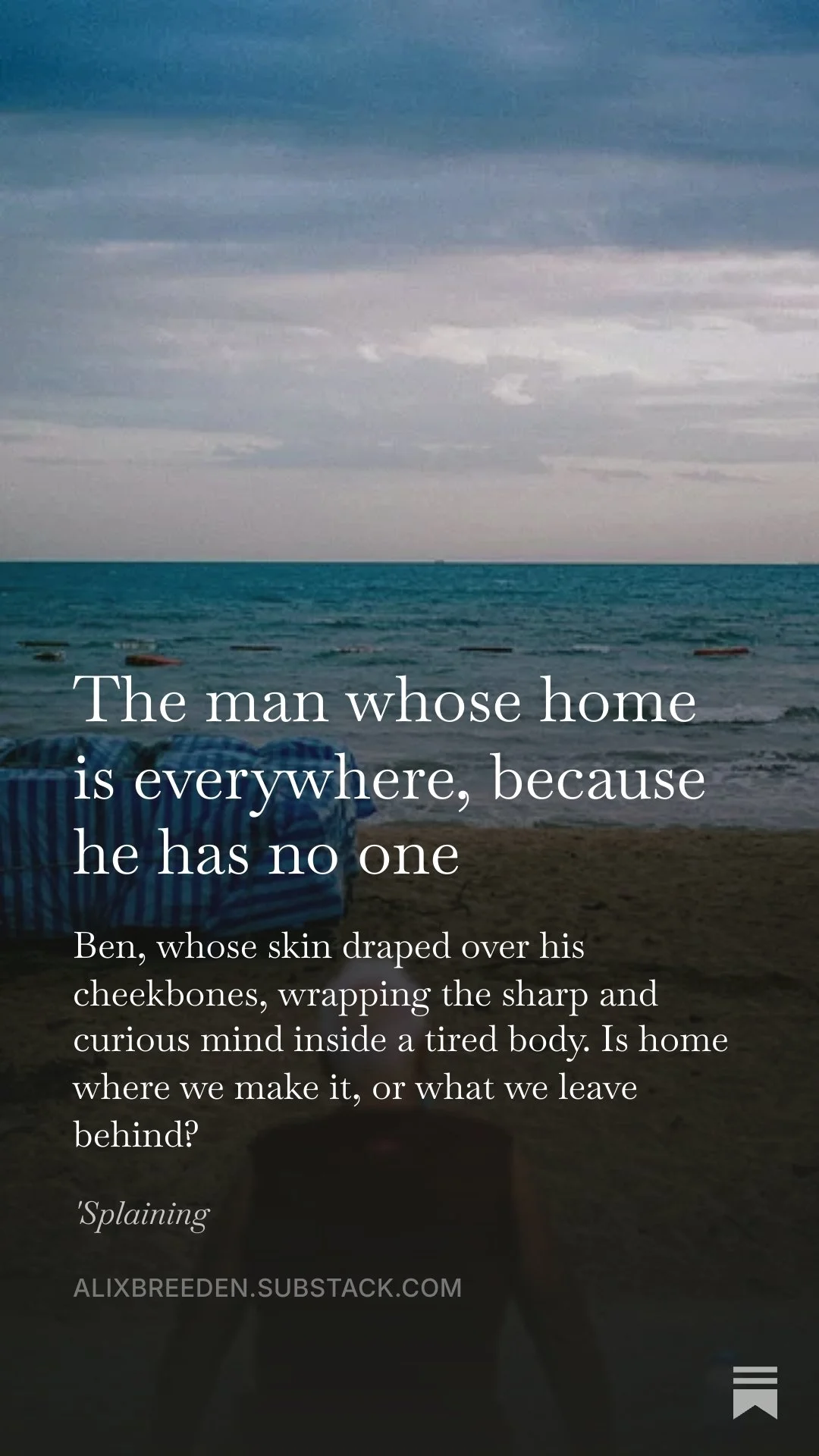
Ben, whose skin draped over his cheekbones, wrapping the sharp and curious mind inside of a tired body. Ben’s story wasn’t just his own, but a shared collective question.
Is home where we make it, or is it what we left behind?
When Ben left his hometown of 250 people for a home off the beach in Central America, did he build a home here? Or is he biding his time until he dies? He seems to think the latter. Maybe a hint of the former, temporarily.
In three weeks, he leaves for Argentina. They have great beef there, he told me. And fly fishing geared towards the mobility-challenged aging community.
He’s missed it— now he can cast his rod from an anchored float.
One last trip before he heads back to the States to cash in on Medicare.
“So they can scrape me up,” as he so colorfully described it, smirking the whole way through the imagery.
Thanks for reading 'Splaining! Subscribe for free to receive new posts and support my work.
Before I said goodbye, I offered to help him from his seat. He declined again, holding steady the edge of the rocking chair to help the very little muscle left on his legs.
Home, for now, is the 7 am breakfast dates he has with his similarly retired friend, Fred.
Home, for the man who has no one, is what he continues to make it. Whether it’s lonely or freeing is only for Ben to decide.
Where we choose to land our hearts can be in people, the familiarity of the past, or it can be in the present moment. The lightness of the unknown.
We, those without anything to return to, have the world as our doorstep. Maybe we find someone to share it with for a while, before our body gives way and we get scraped up like the rest of us.
Travel on, Ben.